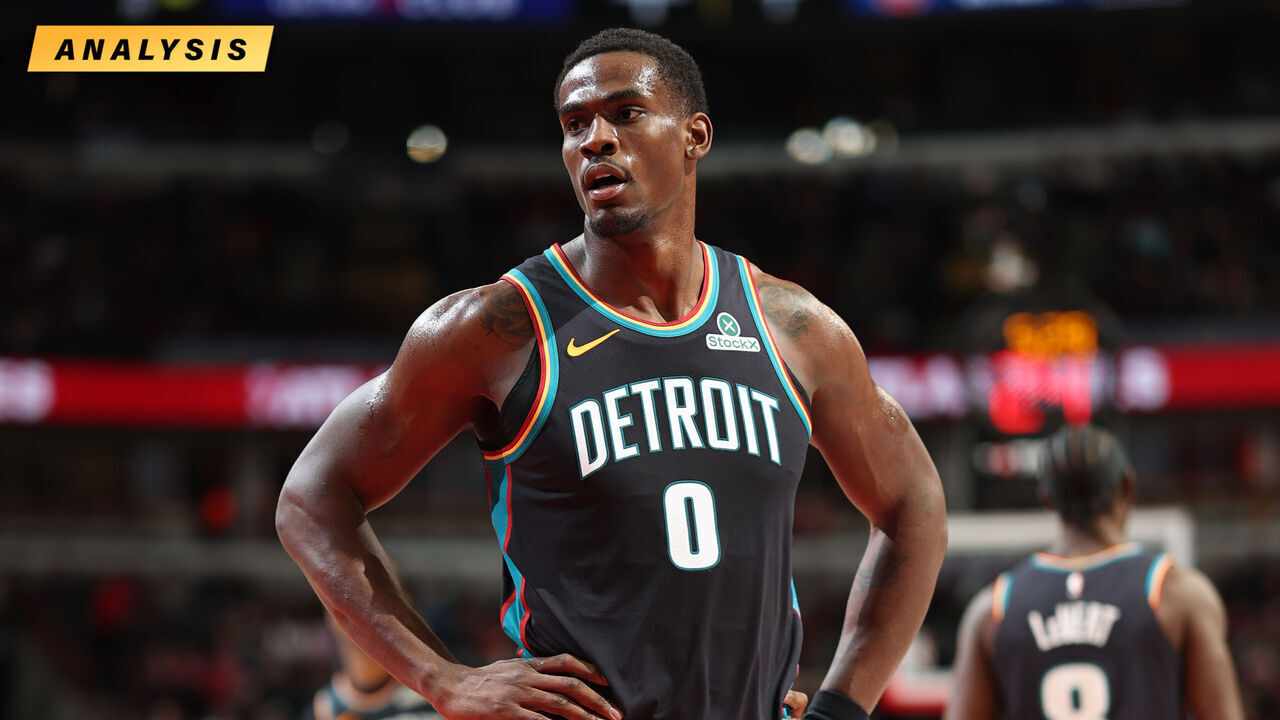
Jalen Duren's long free-agent odyssey ultimately ended in predictable fashion, with the All-NBA center accepting the Pistons' five-year, $200-million offer.
A disgruntled Duren kept the Pistons waiting until the final hours before the deadline for him to accept a potential $9.6-million qualifying offer. That wait saw him skip Detroit's media day and the start of training camp. Had Duren taken the qualifying offer, the 2026 restricted free agent would've become an unrestricted free agent next summer. Instead, he'll be under team control through 2031.
This was always the most financially sound decision. Essentially, Duren had two options: Take $200 million guaranteed right now, or take less than $10 million guaranteed for the chance to earn ... slightly less than $200 million over the same five-year span (after signing with another team).
I don't care how rankled Duren was by a reported weight clause in a prior Pistons offer, or how offended the big man might've been by Detroit's unwillingness to approach his max (worth roughly $287 million). No one hates their workplace enough to actually go with Option 2. Plus, Duren can always try to force his way out later (He becomes trade-eligible Jan. 15).
Now that the posturing is over, both sides can get back to business.
With Duren back in the fold, the Pistons have at least a puncher's chance of contending, even in a reloaded Eastern Conference. Detroit won an East-leading 60 games last season, with Duren, franchise star Cade Cunningham, and All-Defensive forward Ausar Thompson all 25 or younger.
That trio is now under contract for at least the rest of the decade, and their combined cap-hit - worth roughly 70% of the annual salary cap - is perfectly manageable. However, the Pistons will have to surround their franchise pillars with as much shooting as possible to negate the spacing issues that arise when Duren and Thompson share the floor. In the near term, they'll look to fill that void with Duncan Robinson, Isaiah Joe, and John Collins, who combined to make 490 3-pointers last season. An added dose of self-creation would benefit this roster, too.
Still, Duren remains the biggest X-factor (literally and figuratively). The big man's wretched postseason play was the defining story of Detroit's disappointing playoff run, which ended in the second round. It's also the reason Duren - a 22-year-old who just averaged 20 and 10 on a 60-win team - will only be the 10th-highest paid center this season.
| Duren | Regular season | Playoffs |
|---|---|---|
| PPG | 19.5 | 10.2 |
| TS% | 68.8% | 55.3% |
| RPG | 10.5 | 8.5 |
| On/off net | +6.8 | -8.1 |
The Pistons should win their fair share of regular-season games again, but Duren needs to maintain his All-Star form in the spring if Detroit has any chance of competing with New York, Philadelphia, Toronto, Boston, and Cleveland, to name just a handful of the many East contenders. The hesitant, inefficient, out-of-sorts version of Duren who showed up last spring must never surface again.
Even from a cynical viewpoint where Duren already has one foot out the door, it would still be in everyone's best interest for him to play up to his new contract. After all, no one's moving significant assets to pay a playoff faller $40 million per year. Not even Sacramento.
In any event, the big-picture questions can wait. For now, the Pistons should celebrate the fact they finally got Duren to put pen to paper, while Duren, himself, has 200 million reasons to bury the hatchet. The fact it took this long to arrive at such an obvious conclusion is an indictment on everyone involved.
Joseph Casciaro is theScore's lead NBA reporter.